Most ecommerce founders evaluating a paid media provider in 2026 fall into one of three categories. They’re running campaigns in-house and hitting a ceiling they can’t push past. They’re with a generalist agency or freelancer whose ecommerce-specific depth is thin. Or they’re considering a specialist for the first time and don’t know which tier of specialist they actually need.
The question of who to hire has structurally changed since 2020. Performance Max is the default for catalogue-driven brands. Demand Gen is the new top-of-funnel layer. Shopping ads run on AI-managed bidding by default. Conversion value engineering matters more than dashboard ROAS. The provider you hire needs to be fluent in all of this, not just Search.
What follows is a framework for picking the right tier of provider for your account, not a pitch for any particular one. Most ecommerce founders don’t know which tier is right for them until they hire wrong. The cost of hiring wrong is rarely the retainer. It’s the 12 months of compounding inefficiency before you realise.
What “ecommerce PPC” actually means in 2026
Beyond Search, into Shopping, PMax, and Demand Gen
For most ecommerce DTC brands, Search Ads are no longer the largest share of paid budget. Shopping campaigns (the ones that show product images, prices, and merchant ratings) typically run a larger spend share for catalogue-driven brands. Performance Max sits on top, blending Search, Shopping, Display, YouTube, and Discovery into a single AI-managed campaign type. Demand Gen handles the new top-of-funnel surface that used to belong to Discovery campaigns.
A provider managing only Search Ads in 2026 is managing maybe 30% of where your money goes. The other 70% (Shopping, PMax, Demand Gen) requires different skills, different campaign architecture, and different reporting frameworks. Generalist providers who came up running Search Ads in 2018 often haven’t deeply adapted to the catalogue-driven side.
The catalogue feed is half the job
A poorly maintained Merchant Centre feed will sink even strong campaign management. Feed work includes product title structure (where keywords actually live for Shopping queries), GTIN coverage, custom labels for segmentation, product category mapping, and structured data validation. Missing GTINs cause silent disapprovals. Generic product titles lose to competitors who structured theirs properly.
Most generalist providers don’t touch the feed. They treat it as the client’s job or assume the developer set it up correctly at launch. For accounts above $20k a month in spend, the feed layer typically determines 30 to 40% of total spend efficiency. Ecommerce specialists own the feed end-to-end. That distinction alone separates the tiers more than any campaign-management skill.
Conversion value attribution is the new ROAS
Reporting dashboard ROAS at the campaign level hides what’s actually happening to your unit economics. A campaign showing 4x ROAS might be running on low-margin SKUs that lose money after COGS, shipping, and returns. Without conversion value rules, value-based bidding, and margin-weighted conversion actions, the algorithm optimises for the wrong outcome.
This is the silent gap between generalist and specialist work. A generalist will report ROAS and call it done. An ecommerce specialist will configure conversion value to reflect actual margin, build value rules around new versus returning customer segments, and report on margin-after-acquisition rather than top-line revenue.
The three tiers of ecommerce PPC providers
Tier 1: In-house operator
Profile: the founder, marketing manager, or a junior PPC hire running campaigns directly. Cost is the salary plus the opportunity cost of attention that should be going somewhere else.
This tier works when monthly spend is under $3,000 and the catalogue is small (under 20 SKUs with uniform margin). At that scale, unit economics still work cleanly. PMax can run on defaults, Shopping needs minimal feed work, and the brand isn’t yet at the spend level where specialist depth compounds.
It stops working when spend crosses $5,000 a month. That threshold is where PMax requires asset group strategy, Shopping requires feed engineering, and conversion value setup becomes meaningful. A marketing manager doing PPC alongside SEO, email, and social media will never build the depth in any single channel that the account now needs.
The common failure mode at this tier: months of “we’re growing fine” right up until growth plateaus. The plateau is usually a structural problem the in-house operator didn’t have time to investigate.
Tier 2: Generalist agency or freelancer
Profile: a full-service marketing provider running Google Ads alongside SEO, email, social media, or creative production. Or a freelancer who took on Google Ads because the client asked, not because it’s their specialisation.
Cost is typically $1,000 to $3,000 a month in retainer, sometimes structured as a percentage of media spend. The provider does the basics: campaign setup, weekly check-ins, monthly reports.
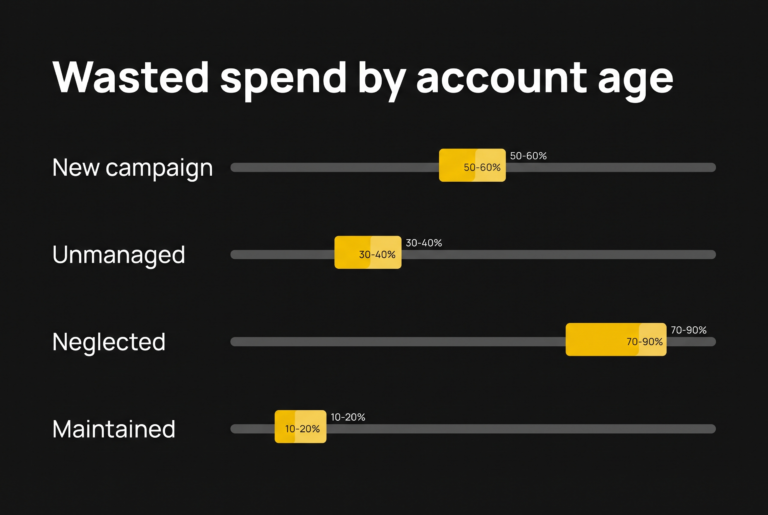
This tier works for small budgets needing basic execution or accounts that are in maintenance mode. It stops working when ecommerce-specific patterns get neglected. Shopping campaigns sit untouched for months. PMax runs on whatever defaults the wizard suggested at setup. Conversion tracking gets configured once and never re-audited.
The common failure mode: the account handler has 20 or more clients. There’s no senior reviewing the account directly. Quarterly reviews always report “things are stable” and growth has flatlined.
Tier 3: Ecommerce specialist (agency or freelance)
Profile: a provider with explicit ecommerce DTC focus, working primarily in Shopping, PMax, and Search for catalogue-driven brands. Either a small senior agency or a founder-led freelance practice.
Cost ranges widely. Freelance senior operators typically charge $1,200 to $3,500 per month for a single account. Specialist agencies typically charge $3,000 to $15,000+ a month depending on account size, complexity, and what else is bundled.
This tier works in the $5,000 to $200,000+ monthly spend range, with 50 or more SKUs across categories or margin tiers, where paid media is a primary revenue channel. Below that range, the cost is hard to justify against simpler alternatives. At very high spend levels, the structural options widen (in-house senior hire becomes economically viable, hybrid models start to make sense), but a senior freelance specialist remains a valid choice well above $200k for brands that prefer that structure.
The common operator profile at this tier: 8 to 15 years of campaign management experience, founder-led practice or small senior team, audit-first engagement model, willingness to refuse work that’s not a fit.
The decision framework
By monthly spend level
The cleanest single signal for tier selection is monthly Google Ads spend. The thresholds aren’t arbitrary. They map to specific operational thresholds in the platform itself.
| Monthly spend (AUD) | Right tier | Why |
|---|---|---|
| Under $3,000 | Tier 1 in-house | Unit economics still work with basic execution |
| $3,000 to $5,000 | Tier 1 or Tier 2 | Decision based on team capacity and catalogue complexity |
| $5,000 to $50,000 | Tier 3 freelance specialist | Sweet spot for senior depth at controlled cost |
| $50,000 to $200,000 | Tier 3 freelance specialist | Senior depth still wins; multi-channel scope can shift toward agency for brands wanting consolidation |
| $200,000+ | Multiple options | Tier 3 specialist still valid, OR rebuild Tier 1 with a senior in-house hire (the spend now supports a full-time senior salary), OR move to Tier 3 agency for multi-brand/multi-market complexity |
Below $3,000 a month, the absolute cost of any external provider eats too much of the spend. Above $5,000, the optimisation surface (search terms, bid strategy, asset groups, Quality Score, conversion value) becomes too large for surface-level management.
The high-spend dynamic is worth pausing on. At $200,000+ a month in spend, a senior in-house PPC lead at $150,000 to $200,000 AUD a year becomes economically reasonable. That salary is 6 to 8% of annual media spend, comparable to or below most agency fee structures. This inverts the common assumption that “more spend means agency.” At the upper end the choice opens up: continue with a senior external specialist, build internal capability, or hire an agency for multi-brand or multi-market complexity. None is automatically right.
By catalogue complexity
Spend tells you the budget. Catalogue tells you the surface area the budget runs across.
Single product or 5 to 10 SKUs with uniform margin: Tier 1 or Tier 2 sufficient. 50 to 500 SKUs across categories or margin tiers: Tier 3 specialist territory. 500 to 5,000 SKUs with seasonality, vertical mix, and margin variance: Tier 3 specialist mandatory. 5,000 or more SKUs across multiple markets or languages: Tier 3 agency or hybrid.
The reason: more SKUs means more decisions about which products get prioritised, how the feed is structured, what custom labels segment the catalogue, and where PMax asset groups carve the inventory into buckets. None of that is one-time setup. It’s ongoing work that compounds with catalogue churn.
By scaling stage
The stage of the business changes which questions matter most.
Validating product-market fit, under $5,000 in spend, testing whether the product converts at all: Tier 1 in-house is fine. The brand isn’t yet at a stage where specialist depth pays back.
Early growth, $5,000 to $20,000 in spend, finding scaling lanes that work repeatedly: Tier 3 freelance specialist is the right call. The brand needs someone who can identify which campaign types and product segments scale efficiently and which don’t.
Mature growth, $20,000 to $200,000 in spend, optimising unit economics across a stable catalogue: Tier 3 freelance or agency, depending on multi-channel scope.
Multi-channel multi-market mature, above $200,000 in spend, operating across paid media, SEO, email, creative, and retention: the choice widens. Tier 3 agency, hybrid (specialist agencies per channel plus an in-house team), or rebuilding Tier 1 with a senior internal PPC lead supported by external strategic input.
By team capacity
The provider tier should match what your internal team can absorb and act on.
If you’re a founder doing everything, in-house PPC becomes unsustainable past $5,000 in spend. The opportunity cost of attention is too high. Outsource.
If you have a marketing manager running 4 or more channels, ecommerce PPC will be the channel that gets neglected. It’s the most technical and the easiest to defer when something else is on fire. Outsource it specifically.
If you have a junior PPC hire who needs oversight, an agency with senior infrastructure is the natural fit. A freelance specialist can work as a periodic auditor or mentor for the junior, but typically doesn’t take on daily oversight as core work.
If you have a senior internal PPC lead, an external specialist works as a strategic input layer (quarterly audits, fresh-eyes reviews) rather than a delivery layer.
When a PPC agency makes more sense than a freelance specialist
The freelance-specialist tier isn’t always the right answer. Agencies are the structurally correct call in specific contexts. Pretending otherwise produces bad hiring decisions in either direction.
Multi-brand portfolio operations
Holding companies running 5 or more concurrent brands, franchise operations across multiple licensees, or portfolio investors managing several DTC properties need a provider with account-handler infrastructure. A freelance specialist running 3 to 5 accounts at most can’t scale to 10 or more parallel brands without dropping execution quality across all of them.
Agencies built specifically for portfolio operations have the account management, reporting templates, and onboarding processes to handle this complexity. A specialist freelancer doesn’t.
Multi-channel buying scope
If your brand wants Google Ads, Meta, TikTok, Pinterest, email marketing, SEO, and creative production all under one roof, a full-service agency provides that coordination. Specialists pick a lane and stay in it.
The trade-off matters: bundling everything with one vendor reduces coordination overhead and gives one accountable contact. The cost is that no single channel gets the depth a specialist would bring. For some brands at some scales, that trade is worth it. For brands where Google Ads is the primary revenue channel and underperformance there matters more than coordination convenience, the specialist wins.
Junior team that needs daily oversight
A junior PPC hire in-house with no senior to learn from is a structural risk. Mistakes get made and not caught. Patterns get missed because the operator hasn’t seen them before. Agencies provide senior oversight as part of their structure, with junior account managers running execution under senior strategic review.
Freelance specialists typically don’t take on training or mentorship work. They run the account themselves at senior level. If your structure relies on having a junior in the seat with senior backup, an agency model fits that requirement better than a freelance specialist.
Extended-hours or crisis-response coverage
Black Friday and Cyber Monday weekend campaigns, multi-timezone operations, or crisis response (account suspension, sudden performance drop) often require coverage beyond what a single operator can sustainably provide. Agency rotation handles this; a single freelance specialist has one person.
This matters less than it sounds for most accounts most of the time. For brands where peak-season operations genuinely require round-the-clock coverage, the agency structure is the honest answer.
When a freelance specialist makes more sense than an agency
For the inverse set of contexts, the freelance specialist tier is the structurally correct call.
Senior operator depth at controlled cost
Agencies bundle senior depth with junior execution. The senior strategist might be on the account for 30 minutes a month. The rest is junior account-handler work. Total fee captures both.
Freelance senior specialists are the senior depth directly on the account, working the optimisation surface themselves. The fee structure typically costs 30 to 60% less than an agency for equivalent senior time, because there’s no junior layer absorbing margin in between.
For accounts where what matters most is senior judgement on every decision (which keywords to test, which PMax asset groups to consolidate, which conversion value rules to deploy), the freelance specialist tier delivers that more efficiently.
Direct senior access, no account-handler layer
A freelance specialist relationship has one person on the other end. Slack or email goes straight to the operator running the account. No “I’ll need to check with the team” delays. Strategic decisions get made in real time with the person who’ll execute them.
Agency relationships typically have an account handler as the primary contact, with senior strategy happening behind the scenes. This is fine for low-velocity accounts. For accounts where the optimisation surface moves weekly and decisions need to happen quickly, the layer in between adds friction.
Single-channel mastery over multi-channel breadth
Specialists go deep in Google Ads, Shopping, and PMax. They don’t try to also run Meta, SEO, email, or creative. The reader who hires a freelance specialist accepts the trade: senior depth in one channel, separate specialists per other channel as needed.
For brands where Google Ads is the dominant revenue channel and quality there matters more than vendor consolidation, this trade pays off. For brands where multi-channel coordination is the bigger value, an agency wins.
The $5,000 a month minimum where senior depth starts paying off
Below $5,000 a month, the cost of any senior external provider eats too much of the spend. The break-even point is somewhere in the $3,000 to $5,000 range depending on catalogue complexity. Below that, an in-house operator or generalist freelancer is the economically correct call regardless of how good the specialist is.
Above $5,000 a month, the freelance specialist tier dominates on cost-effectiveness compared to agencies. The senior depth that an agency delivers via expensive structure, a freelance specialist delivers via direct attention. The fee structure aligns with the value being created. The upper end of this tier isn’t a hard ceiling: at very high spend the structural options widen (covered in the “Outgrowing your tier” section below), but the freelance specialist remains valid throughout.
Signs you’ve outgrown your current tier
Most provider switches happen too late. The signals that you’ve outgrown your current setup are usually visible months before the decision gets made.
From in-house to specialist
Spend has crossed $5,000 a month and Performance Max is still on default settings. Conversion tracking has been “fine for years” with no recent audit (it probably isn’t fine). The search terms report hasn’t been reviewed in 3 months or more. The Shopping feed hasn’t been touched since launch; custom labels are empty and product titles pull whatever the Shopify export defaulted to. The marketing manager keeps saying “I’ll get to Google Ads next week” and next week never comes.
Any two of those signals together means the in-house model has structurally broken down. Hiring a specialist isn’t an admission of failure. It’s recognising that the surface area has grown past one person doing four channels.
From generalist to ecommerce specialist
The account handler can’t answer specific questions about feed structure when you ask. “We’ll look into that” is the standard response. PMax campaigns run with no asset group strategy: all products, all assets, one campaign, optimise. Monthly reporting is still ROAS-only with no margin-weighted conversion view. Returns and shipping costs aren’t reflected anywhere. Quarterly reviews always say “things are stable” but growth has plateaued for 6 months or more. When you ask about conversion value rules, value-based bidding, or new-versus-returning segmentation, the answers feel vague.
The generalist provider isn’t necessarily incompetent. They’re delivering generalist execution at generalist depth. Ecommerce-specific patterns need specialist work and you’re past the point where generalist work is enough.
When to consider other structures at high scale
Monthly spend is approaching or exceeding $200,000 across markets. You’re adding 3 or more new markets or languages concurrently in the next 6 months. Peak season requires extended-hours coverage that a single operator can’t sustainably deliver. The internal team has grown to a size where a single external operator can’t provide the cross-team coordination, training, and reporting structure required.
At this scale, the question stops being “specialist or agency” and becomes “what structure fits the business now.” Three real options:
A specialist agency makes sense for multi-brand portfolio operations or where multi-channel coordination across paid media, SEO, email, and creative is the bigger value than per-channel depth.
A senior in-house hire becomes economically viable. At $200,000+ in monthly spend, a $150,000 to $200,000 AUD/year senior PPC lead is 6 to 8% of annual media spend, comparing favorably to most agency fee structures. Some brands at this scale rebuild internal capability and use external specialists as quarterly auditors or strategic input.
A freelance specialist still works for brands that prefer senior depth without internal complexity. The “single-operator capacity” framing is a generalisation that doesn’t apply to every specialist, and not every high-spend brand wants to manage either an agency relationship or a full-time internal hire.
The shift at high scale isn’t about leaving specialists behind. It’s about having more options than you did at $50,000 in spend.
Questions to ask any provider before hiring
Whichever tier you’re considering, the discovery conversation tells you most of what you need to know. The right questions surface depth or its absence quickly. What to check before you sign is in how to hire a Google Ads specialist.
About their ecommerce-specific depth
“Show me a Shopping feed you’ve optimised. What changed and what was the impact on Shopping campaign performance?”
A provider with real Shopping depth will have specific examples with numbers. A provider without will give vague answers about “best practices” without specifics.
“How do you structure Performance Max asset groups for a multi-category catalogue?”
Listen for: separation by margin tier, separation by intent stage, separation by new versus returning customer, supplemental feeds for promotion-led pushes. Vague answers about “one PMax campaign with everything” is the red flag.
“Walk me through how you set up conversion value rules for an account with margin variance across SKUs.”
If they don’t know what conversion value rules are, or how value-based bidding works in Smart Bidding strategies, they’re below the specialist threshold regardless of what their pitch deck says.
About their process and reporting cadence
“What does your typical onboarding look like in the first 30 days?”
Listen for: audit week, structural-change weeks, ongoing optimisation weeks. Vague “we’ll get into it” answers signal no defined process.
“How often will I hear from the senior on my account, not the account handler?”
For agency hires, this is the critical question. If the answer is “monthly strategy calls only,” then the senior is spending maybe 2 hours a month on your account. The other 38 hours of attention come from the junior.
“What does your monthly reporting include beyond ROAS?”
Listen for: margin-weighted conversion value, new-versus-returning split, search terms commentary, structural changes made and why, what’s being tested next. ROAS-only reporting is generalist work.
About their commercial model
“Is your fee a flat retainer, a percentage of media spend, or hybrid? Why that structure?”
Flat retainer aligns incentives at scale. Percentage of spend creates a structural conflict of interest: the provider’s revenue grows when your spend grows, regardless of whether the additional spend earns its return. This is the most common model in the agency market, but the incentive misalignment is real. A provider on percentage of spend has a built-in reason to recommend higher budgets and broader targeting even when efficiency would be better served by tightening. Hybrid models can work if structured around outcomes rather than spend. Listen for whether they’ve thought about why their model is the way it is.
“What’s the notice period and what triggers it?”
Reasonable answers: 30 days mutual notice, with clear handover expectations. Red flags: long lock-in periods, vague exit terms, automatic renewal clauses.
“Do you offer any performance guarantees, and what exactly do they cover?”
Most credible providers don’t promise specific performance numbers (the variables are outside their control). Some offer process guarantees: audit findings delivered by a specific date, refunds if specific deliverables aren’t met. That’s the honest version. Performance guarantees on ROAS or CPA are usually marketing.
For an example of a structured discovery process, Adgenix uses an audit-first engagement model (the Free Revenue Leak Report) before scoping any retainer. That pattern keeps both sides honest about what’s actually in the account before committing.
Frequently asked questions
What does an ecommerce PPC agency typically charge?
Specialist agencies typically charge $3,000 to $15,000 a month or more, depending on account size and what’s bundled. Freelance senior specialists typically charge $1,200 to $3,500 per month. Percentage-of-spend models charge 10 to 20% of media spend. This is the most common pricing model in the agency market, but it carries a structural conflict of interest: the provider earns more revenue when your spend grows, regardless of whether the additional spend earns its return. Hybrid models combine a base retainer with performance bonuses or spend-based components. Flat retainers are the cleanest alignment of incentives but less common at the agency tier.
Is an ecommerce PPC freelancer worth it compared to an agency?
In the $5,000 to $200,000 monthly spend range, a senior freelance specialist typically delivers comparable or better results than an agency at 30 to 60% of the cost, because the entire fee captures senior time directly rather than a senior plus junior structure. Outside that range (below $5,000 spend or above $200,000), the agency model usually fits better. The trade-off is single-operator capacity: a freelancer runs 3 to 5 accounts, an agency runs many more.
How long does it take an ecommerce PPC provider to show results?
Audit findings and quick wins typically deliver in weeks 1 to 2. Structural changes (campaign rebuilds, feed optimisation, conversion value engineering) settle in weeks 3 to 4. Smart Bidding strategies and Performance Max need 30 to 50 conversions to stabilise after any structural change. Accounts with thin conversion data take longer because the algorithm has less to learn from. Genuine performance lifts usually become measurable in the 60 to 90 day window.
Should I hire one provider for Google Ads and another for Meta Ads, or one for both?
The first question is whether you should be running the second channel at all. If one channel is profitable and not yet at its scaling ceiling, adding a second channel typically dilutes attention and budget more than it adds revenue. Add the second channel when the first has reached its limit: CPCs plateauing despite optimisation, search volume capped, returns diminishing on incremental spend. Once you’re running both channels, the choice between one multi-channel provider and two single-channel specialists trades coordination for depth. Single-channel specialists per channel produce deeper per-channel work, while multi-channel agencies produce coordination across channels. For most ecommerce DTC brands where Google and Meta both drive meaningful revenue, single-channel specialists per channel outperform a multi-channel agency where both channels get partial senior attention.
What’s the difference between an ecommerce PPC agency and a Google Shopping specialist?
Ecommerce PPC providers cover Search, Shopping, Performance Max, and increasingly Demand Gen across the full Google Ads surface for ecommerce brands. A Google Shopping specialist focuses specifically on the Shopping and PMax campaigns and the underlying Merchant Centre feed. The Shopping specialisation is a narrower subset of ecommerce PPC. For brands where Shopping represents the bulk of paid revenue, the deeper specialisation pays off. The when to hire a Google Shopping specialist framework covers that decision in more detail.
Where Adgenix sits in the framework
Adgenix is the freelance senior specialist tier. Single senior operator, 8+ years in paid media, with deep specialisation in ecommerce DTC. The accounts where Adgenix produces the best work start at $5,000 a month in Google Ads spend and scale upward from there with no hard ceiling on the upper end.
The work is Google Ads, Google Shopping, and Performance Max. Other channels (Meta, SEO, email, creative production) are out of scope for this specialisation. Brands typically run those with separate specialists per channel or in-house. The strongest results come from clients who want senior depth on Google specifically rather than vendor consolidation across all channels.
The engagement model is audit-first. Before scoping any retainer, there’s a Free Revenue Leak Report that surfaces what’s actually in the account. That keeps both sides honest about whether the fit makes sense. Some audits result in retainer engagements. Some result in a list of fixes the client implements themselves. Both outcomes are fine.
Adgenix serves Australian ecommerce brands nationally, based in Melbourne. The Google Shopping specialist track is the entry point for ecommerce-focused engagements where Shopping and PMax are the primary surface area. For general Google Ads work that spans Search alongside Shopping and PMax, the Google Ads consultant track is the broader entry point.
The audit is the cleanest first step regardless of which tier you eventually pick. Even if the framework above points you toward staying in-house or hiring an agency, the audit findings tell you what your current setup is missing. That’s useful for any tier conversation.
Book the Free Revenue Leak Report to see what your account is leaking before you make the tier decision.
For WooCommerce-specific setup considerations, see the Google Ads + Shopping setup guide for WooCommerce stores.