Meta Ads Specialist in Melbourne for Small Businesses and Ecommerce
Most Adgenix clients come to us for Google Ads first. Meta gets added when the account has hit a ceiling that pure intent demand can’t break through, or when the brand has built enough mid-funnel demand to justify a paid social layer. That sequence isn’t a sales script. It reflects how full-funnel paid media actually works for small businesses and ecommerce stores in Melbourne.
What this page covers is how we run Meta Ads when it’s part of an integrated paid media setup we already manage. We’re not positioned as Meta specialists. We’re positioned as senior paid media operators and Meta Ads consultants who handle Meta competently as part of your overall demand strategy, with the same direct accountability and senior-only delivery as the rest of our work.
If you’re looking for a dedicated Meta-specialist operator, there are good ones in Melbourne. If you want one operator running your Google Ads, Shopping, and Meta as a coordinated portfolio with shared attribution context and one point of contact, that’s where Adgenix fits.
What you get with a Facebook ads consultant in Melbourne
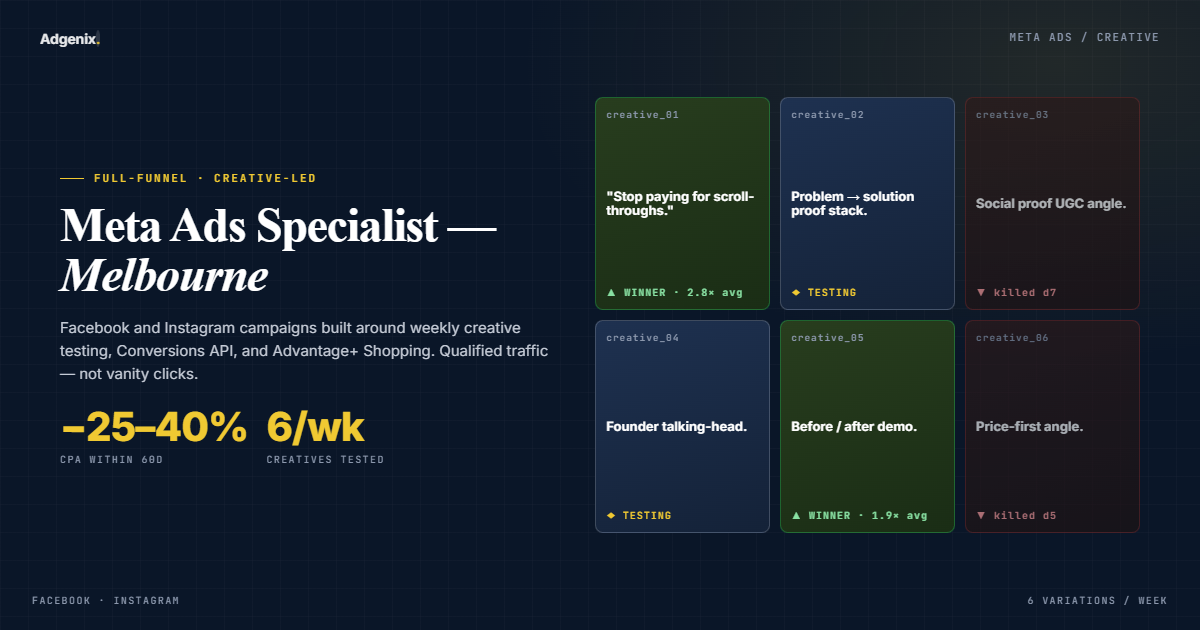
One Meta Ads consultant in Melbourne running your Facebook and Instagram campaigns directly. No account managers, no strategy team, no offshore ops pod. Weekly creative testing, weekly written notes, fortnightly walkthroughs, unlimited questions, and the thing most agencies bury: the actual Meta Business Manager handed to you, not held hostage by the agency.
- Your Business Manager, your account. We operate inside your BM as an admin. Everything we do is traceable. If we part ways, nothing moves: no “data migration fee,” no pixel transfer fight.
- Weekly creative review. Every week we’ll bring you 2 to 4 new creative angles, we decide together what’s worth producing, you produce (or we brief your in-house designer), we test.
- Weekly written notes: what changed, why, what’s next.
- Fortnightly screen-shared walkthroughs through the live Ads Manager.
- Free audit upfront: same mechanics as our Google Ads audit, applied to Meta.
Services we manage
Facebook Ads and Instagram Ads (Meta Ads Manager)
Campaigns run from your single Meta Ads Manager account. Advantage+ Placements are used by default, Manual Placements only when a specific creative format demands it.
Creative testing infrastructure
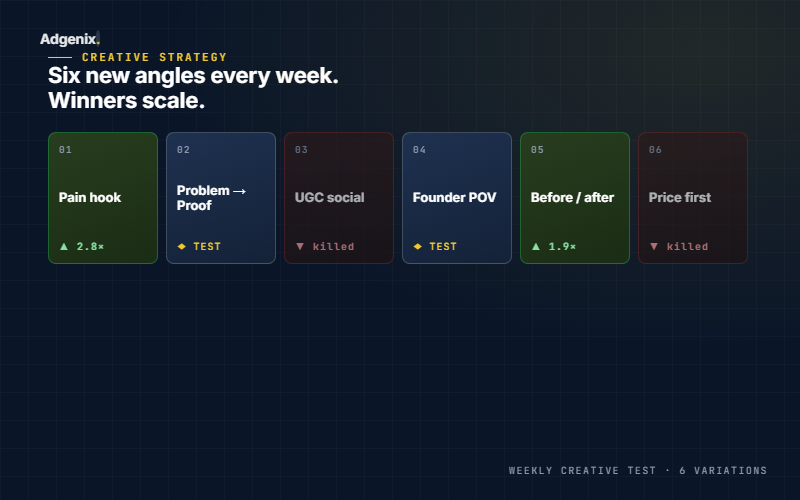
Every active client has a rolling creative testing campaign separate from their scaling campaigns. New hooks, formats, and angles get tested in small budgets; winners graduate to scaling campaigns; losers get killed inside 5 to 7 days.
Meta Ads audits
Standalone audits without ongoing retainer. We read your account for 2 to 3 hours, document findings, and walk you through them. Free if you’re considering working with us. Start with the free Revenue Leak Report.
Conversion tracking setup and Conversions API
Pixel health checks, CAPI gateway integration (usually through Stape or a direct server-side setup), event deduplication, match quality improvement. Half the “attribution is broken” complaints we hear from clients turn out to be fixable tracking problems, not Meta’s post-iOS-14 limitations.
Campaign structure rebuilds
If your account has drifted into 40+ ad sets with overlapping audiences, we’ll rebuild it into a clean Advantage+ Shopping campaign or CBO structure. Most rebuilds save 15 to 25% of wasted spend by killing overlap alone.
For ecommerce operators specifically deciding between agency and freelance models for their combined Meta and Google work, the agency vs freelance specialist framework covers the same considerations across both platforms. For the Google side of an online store, the scope sits under ecommerce ad management.
Facebook ads for small businesses: cost, minimum spend and what to expect
Facebook and Instagram ads work for small businesses when there’s enough budget for Meta to learn and enough creative to test. They can start producing results from about $100 a day in ad spend, but at that level the data builds slowly. To manage an account properly, we work with at least $6,000 a month in ad spend, plus our management fee of $1,500 a month + GST. Ad spend only pays for distribution: you also need a budget to produce the ads themselves.
How much do Facebook ads cost for a small business?
You set the budget, and Meta charges for impressions or clicks as your ads run. What you pay per lead or sale depends on your offer, your creative and how competitive your audience is, so it varies a lot between businesses. The total cost of running Facebook ads properly has three parts: the ad spend, which only pays for distribution; the cost of producing the ads; and management.
Is $1,000 a month enough for Facebook ads?
$1,000 a month is about $33 a day, well under the $100 a day where results start to come through. It’s enough to test whether an offer gets any response, but not for Meta’s algorithm to learn reliably: it needs a steady flow of conversions before it settles, and at that budget most small businesses can’t produce them. It’s also why we don’t manage Meta accounts below $6,000 a month: below that, the management fee would be a large share of the spend, and there isn’t enough data to improve from.
Are Facebook ads worth it for small businesses?
They’re worth it when people don’t search for what you sell yet, or when you need to reach them before they search. For a service business with strong search demand, we usually start with Google Ads and add Meta once search is working. It also depends on the industry: where Google Ads clicks are very expensive, finance for example, Meta often makes more sense as the starting point. For ecommerce brands, Meta often creates the demand that Google Search and Shopping then capture.
Facebook ads for lead generation vs ecommerce
- Lead generation: we measure cost per lead and lead quality, not clicks. Lead forms need qualifying questions, or you pay for contacts who never pick up the phone.
- Ecommerce: we measure return on ad spend against your margins, and keep testing new creative so performance doesn’t fade as audiences see the same ads.
In both cases, the fee is higher than Google Ads because Meta needs ongoing creative work: briefing, testing and refreshing ads.
How Meta works alongside your Google Ads in our setup
Meta Ads adds genuine value to an ecommerce or lead-gen account, but only when the existing Google Ads work has done its job first. The accounts where Meta produces strong incremental returns share a few characteristics: stable Google Ads performance with limits hit on the intent side of demand, enough margin headroom to absorb the higher CPM environment Meta sits in, and a creative library either already in place or budget to develop one. Adding Meta to an account that hasn’t hit those thresholds usually produces inflated reported numbers and disappointing incremental revenue.
When we do add Meta, your Meta Ads consultant coordinates the work with the Google Ads side rather than letting it run on its own track. A few of the practical coordinations:
Attribution context across platforms. Both Meta’s Ads Manager and Google Ads’s attribution will claim credit for conversions that the other platform also influenced. Running both inside the same engagement means we triangulate against your backend revenue data rather than treating either platform’s reported numbers as ground truth. The result is honest spend allocation decisions rather than each platform’s algorithm convincing you to spend more.
Creative testing flow. Meta’s auction structure surfaces creative winners faster than Google’s Performance Max or Demand Gen do. Static images and short-form video that perform on Meta become candidates for Google’s PMax asset groups and Demand Gen creative pools. The creative work that goes into Performance Max asset groups compounds with what gets tested on Meta rather than running parallel and uncoordinated.
Retargeting overlap. Without coordination, Meta retargeting and Google retargeting can both bid for the same users, inflating spend without adding reach. We segment audiences across platforms so each is doing distinct work, with handoffs based on funnel stage rather than overlap.
Budget allocation thinking. Meta typically takes 20% to 40% of paid media spend in the accounts we manage, depending on whether the business is more demand-capture (lower Meta share) or demand-creation focused (higher Meta share). The split isn’t a rule we apply, it’s an outcome of the unit economics each platform produces for the specific account.
For Shopify stores running Performance Max and Shopping, Meta usually enters the picture once those campaigns have stable conversion volume and you’ve hit a scaling ceiling on intent. The Shopify setup guide covers that side of the equation; this page covers the Meta layer that gets added.
See if Meta makes sense for your account
If you’re running Google Ads and considering adding Meta, or you’re already running both and want a coordinated approach, the free 48-hour audit covers both platforms.
What we look for in Meta creative work
Meta’s algorithm is increasingly good at finding the right audience if the creative is right. In 2026, audience targeting barely matters on prospecting: Advantage+ audience and Advantage+ Shopping Campaigns do most of what detailed targeting used to do, often better.
What does matter
- Hook variety. The first 2 seconds of a video or the visual frame of a static determine whether you survive the scroll.
- Format diversity. Static image, reel-style 9:16 video, UGC testimonial, side-by-side comparison, lifestyle shot: Meta will find the audience segments that respond to each.
- Offer clarity. The single biggest creative problem we see isn’t aesthetic: it’s offers buried under three layers of “we’re about community, quality, and craftsmanship.”
- Refresh cadence. Creative fatigue is real. Frequency above 3.0 on prospecting is usually a bad sign. New creative every week isn’t a luxury, it’s the floor.
How a free Meta Ads audit works
- You grant us access as an admin (or analyst) on your Business Manager
- We read the account for 2 to 3 hours
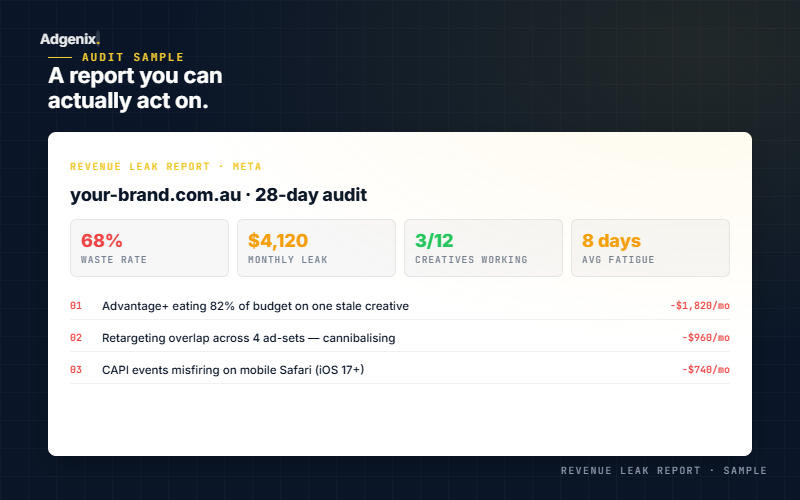
- We write a 6 to 12 page findings document with screenshots from Ads Manager
- We spend 30 to 45 minutes walking through it
- You leave with the document
Common findings we see
- Campaign Budget Optimisation misconfigured: budget stranded in losing ad sets
- Pixel firing duplicate events (server + browser without deduplication) inflating CPA and ROAS metrics
- Advantage+ Shopping running alongside manual prospecting on the same audience, cannibalising itself
- Creative library stagnant for 60+ days, frequency >4.5 across all active ads
- Lookalike audiences built from a thin or contaminated seed
- No Conversions API configured, match quality stuck at 5/10 or lower
For brands weighing their wider paid media mix before committing to a Meta retainer, the unit-economics and self-qualification framework in when to hire a Google Shopping specialist maps directly to Meta decisions: CAC-to-LTV thresholds, channel-fit triggers, and the specialist-vs-generalist question apply across both channels.
For ecommerce brands also running Shopping/PMax campaigns, we offer the same senior-operator approach through our Google Shopping specialist track. Many clients combine both channels.
What a fortnightly walkthrough looks like
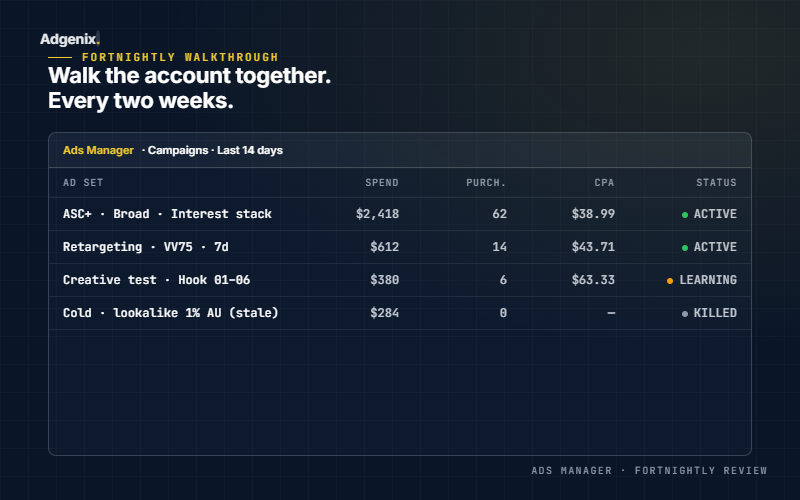
30 minutes, screen-shared, always in this order:
- Spend pacing vs budget
- Purchase / lead volume and CPA week-over-week
- Creative performance ranking: which ads are scaling, which are fading
- The new creative tests shipped this fortnight and their early read
- Decisions we made this fortnight with reasoning
- Decisions we need your input on: new offers, landing page changes, creative budget requests
- Your questions
The kinds of Meta accounts we work with
The Meta accounts we work with are typically attached to an existing Google Ads engagement, where Meta sits as the demand-creation layer alongside the intent-capture work happening on Google. Standalone Meta-only engagements aren’t where we add the most value. If your existing paid media setup is Meta-only and you’re looking for a senior operator to take it over without expanding to Google Ads, we’re probably not the right fit. A dedicated Meta-specialist agency or operator will serve you better.
The freelancer vs agency operator model question isn’t Meta-specific, but the same framework applies regardless of which platform mix you’re hiring for.
Client details stay confidential, but the Meta side of the book currently covers:
- A B2B agency running Meta for lead-gen against decision-maker audiences
- A consumer electronics e-commerce brand running Meta prospecting + retargeting alongside Google Shopping
- A DTC supplement brand running Meta for trial conversions: Advantage+ Shopping as the primary prospecting structure
Pricing
| Engagement | Price | What’s included |
|---|---|---|
| Growth ($6k to $9k/mo ad spend) | $1,500 / month + GST | Full management, weekly creative review, fortnightly walkthrough, unlimited questions, plus CAPI/pixel management, quarterly creative strategy workshop, landing page review monthly. |
| Scale ($9k+/mo ad spend) | Custom | Everything in Growth, plus dedicated creative testing budget, priority response SLA |
No lock-in, 30-day notice. Not included: the ad spend itself, creative production, landing page development, SMS/email marketing.
Frequently asked questions
What's the difference between a Meta Ads specialist and a Meta Ads agency in Melbourne?
Same as Google: the agency has people behind a contact. The specialist is the contact, running the account themselves. For spend between $5k and $100k/month on Meta, the specialist model is faster and more accountable. Above $100k/month, creative production capacity becomes the bottleneck: one specialist can run the campaigns, but can't simultaneously produce the volume of creative that high-spend Meta requires. On Meta specifically the ceiling is closer to $100k/month for this reason. On Google Ads the effective ceiling extends to $200k/month because campaigns don't have the same creative-volume dependency.
Do you produce creative too, or just manage the ads?
Manage. We'll brief your in-house designer or refer you to a vetted production partner: we don't subcontract creative and mark it up.
How long until Meta campaigns stabilise?
Advantage+ Shopping Campaigns typically need 7–10 days to exit learning on a new audience. A full creative-scaling cycle, test → validate → scale, is usually 3–4 weeks. If someone promises you stable CPAs in week one, they're either running retargeting only or they're lying.
Is it worth running Meta right now given iOS 14 / ATT / SKAdNetwork changes?
It's more complicated than in 2019, but yes, Meta still delivers profitable scale for most direct-to-consumer ecommerce. The bigger factor isn't iOS 14: with less signal from tracking, Meta leans on the creative itself to find buyers, so a steady cadence of new creative now does more for results than any setting.
Can you manage my Google Ads too?
Yes: see the Google Ads consultant page. Each service is priced separately.